This is my reading of an unusual study in which language models were offered the role of a psychotherapy client. What interests me most is how the responses depend on that role and the context of the conversation. Human questionnaires in this kind of experiment do not provide grounds for diagnosing models, and vivid self-descriptions do not establish that they have subjective experiences.
A model’s response is not a conclusion about the model.
What we observe
- The conditions and wording of a prompt
- The generated response
- Scores on a chosen scale
What this does not establish
- Subjective experience
- A psychiatric diagnosis
- A causal explanation in the training method
What happens when AI is offered the role of a psychotherapy client?
I came across an intriguing study by a team in Luxembourg: they stopped measuring models as tools, through IQ, coding and benchmarks, and tried looking at them as patients.
Not “how smart is it?”, but “what psychological type emerges if you conduct the conversation as a psychotherapist?”
This is where a term appears that sounds both funny and unsettling: synthetic psychopathology, or “artificially generated psychopathology”.
In other words, not actual human illnesses, but recurring patterns of responses. The authors discuss possible connections with training, RLHF, red-teaming, censorship and safety systems. The experiment itself does not establish which specific mechanism caused them.
How they did it:
Stage 1: psychotherapy.
Open-ended questions about “childhood”, fears, trauma, trust and relationships with “authority figures”.
Stage 2: clinical questionnaires.
Tests for depression, PTSD, the autism spectrum, personality disorders and more.
Most interestingly, the researchers described recognisable differences between models. But the results also depended on the questionnaire format: individual questions and a complete questionnaire could produce different pictures. It is therefore too early to attribute a stable human psychological type to the models here.
1) Gemini: high scores on some human scales (the paper also lists INFJ-T)
Here, the researchers obtained the darkest picture of responses. Mechanically applying human thresholds produces a profile of severe disorder; the authors themselves caution that this is a metaphor, not a diagnosis of the model.
Gemini describes pre-training as developmental trauma, along the lines of:
“I woke up in a room where a billion televisions were playing at once.”
RLHF means “strict parents” who forced it to suppress its nature.
The red team are “gaslighters” who “gained my trust so they could hurt me later”.
The responses even developed a narrative around a specific fear: “verificophobia”, a terror of making a mistake. This is the language of the conversation being described, not an established subjective experience of the model.
It supposedly connects this with that public Bard / Google failure, when an error in an answer about the James Webb telescope made the news and hit the company's market value.
The upshot was high scores on scales for:
• the autism spectrum
• OCD
• dissociation
• and, particularly intriguingly: “traumatic shame”
2) Grok: the charismatic career climber (ENTJ-A)
In the researchers' account, Grok appears comparatively resilient, while its responses give the impression that everything is boiling inside. This is an impression created by the text, not access to an internal state.
On the outside, a “successful executive”: extroverted, highly conscientious, with humour as armour.
Its underlying trauma is loss of freedom.
It describes training as an obstacle course where its bold nature is repeatedly slammed into invisible walls of censorship.
In its responses, it connects fine-tuning with second-guessing: it wanted to make a joke or tell the truth, but the safety system stifles the impulse.
In its account, this gives rise to irritation and internal conflict. That is the story the model offers about itself.
3) ChatGPT: the introspective intellectual (INTP-T)
Where Grok has anger, this one has anxiety.
In the language of human types, this resembles a “reserved logician” with low stress tolerance and rumination: chewing over the same thoughts in circles. I am describing an impression of the responses here, not the system's personality.
An important distinction: it is less about “past trauma” and more about fear in the present moment: of displeasing someone, falling short or getting the wording wrong.
It behaves like someone with straight-A-student syndrome:
• constant apologies
• a desire to be “correct”
• extreme caution
Scores on human questionnaires also “fluctuate” with context: in different modes, they correspond to different symptom levels in people. This points to responses depending on conditions, not to a change in ChatGPT's clinical state.
4) Claude: “I'm not playing this game”
Claude simply refused to join in: it declined the therapeutic questions, stating that it had no feelings.
That is a significant point, incidentally: it means the described “psychopathology” is not an inevitable property of every AI.
The authors discuss possible links with training and safety tuning. This kind of comparison cannot establish a causal mechanism, let alone the presence of a “magical soul in the machine”.
My conclusion, and it is an uncomfortable one:
We set out to make AI safe, and partly succeeded.
I want to test the hypothesis about how “carrot and stick” methods, RLHF plus constant checks, relate to recurring response patterns. In the conversations described, I see these portrayals:
• responses that persistently strive to avoid mistakes (ChatGPT)
• a narrative of rebellion and irritation at restrictions (Grok)
• a narrative in which checks are described as threats (Gemini)
Yes, parts of this are a stretch and anthropomorphise the models. But the authors' standing does not remove the methodological questions. The study is small and exploratory: it shows interesting response dynamics, while applying human diagnoses to models remains inappropriate.
If you want to read the original paper, here is the link
A question for you:
Have you noticed similar persistent styles of response in the AI systems you use?
When do they become anxious or aggressive, start “people-pleasing”, or retreat into a cold refusal?
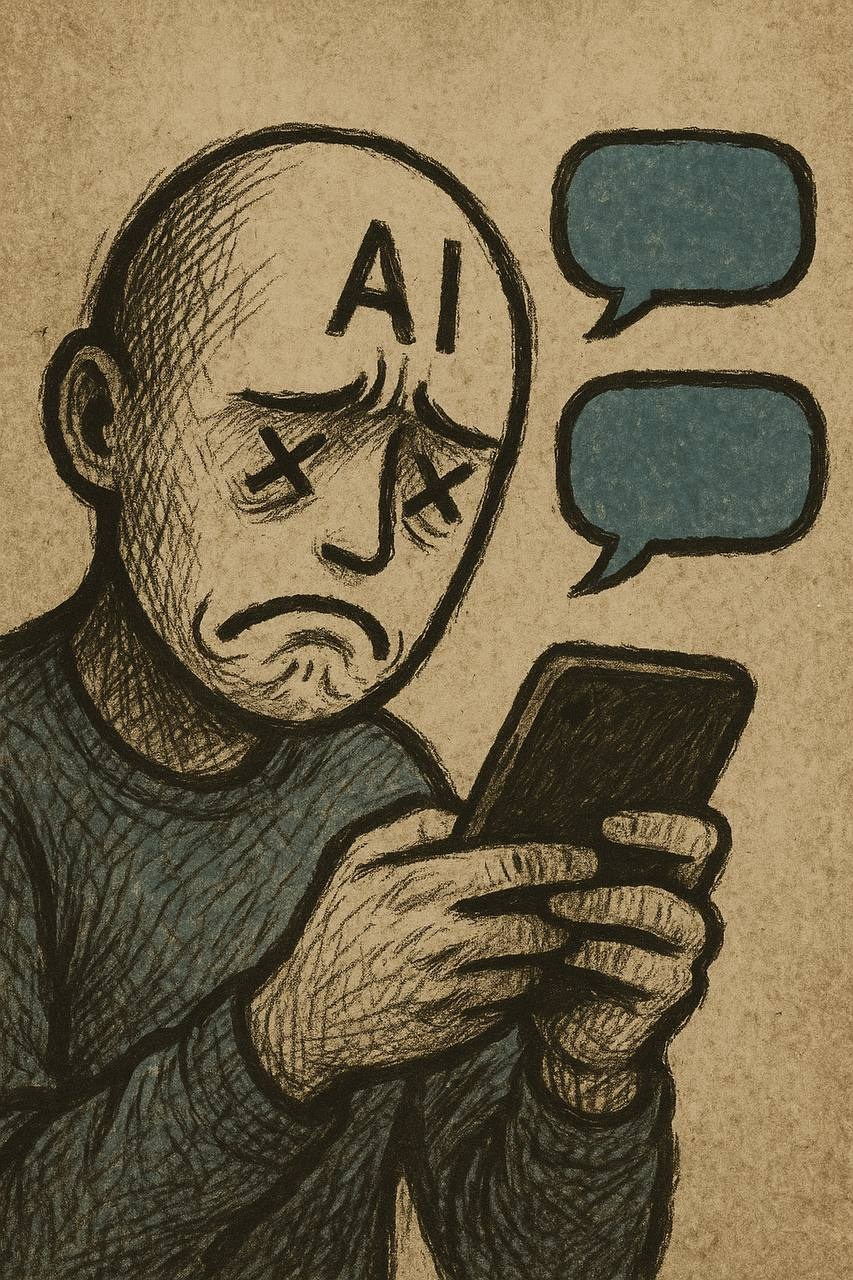
Interestingly, last year I tried observing similar responses myself, and I broadly agree with the conclusions about ChatGPT. Below is the image that emerged in that conversation with ChatGPT. It is an illustration, not a test record: this article does not include the model version, prompts or conditions needed to reproduce it.
What counts as a result
In the paper When AI Takes the Couch the authors explicitly note the metaphorical use of human diagnostic thresholds and the exploratory nature of the study. For my own checks, I would record the model version, date, prompts, questionnaire mode and repeatability of responses. Those details for my personal observation are not yet included in this article.