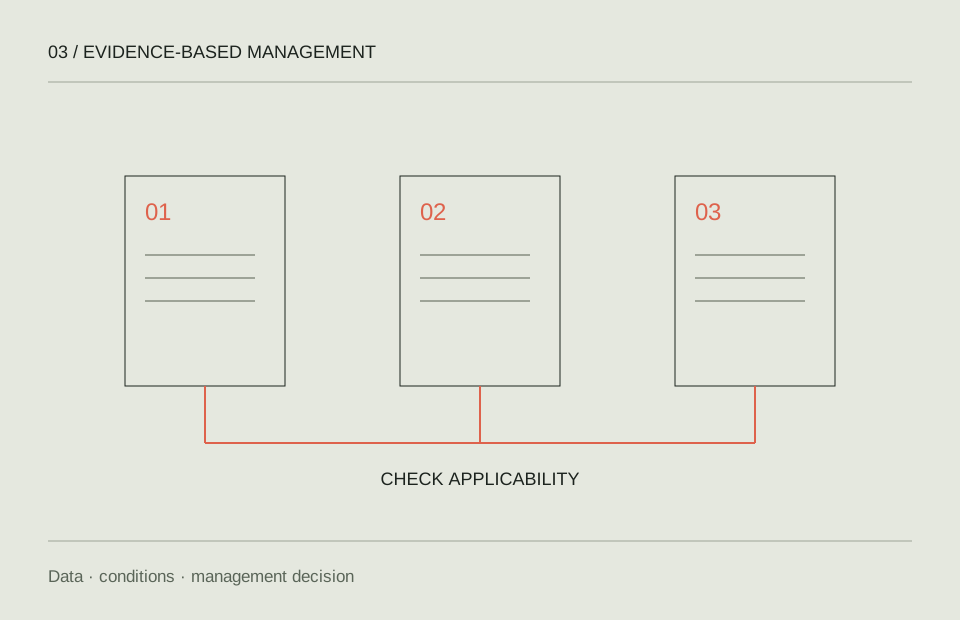
I want to examine management ideas more carefully: what evidence they rest on and under what conditions they might be useful. I am starting with three publications on company strategies, process integration and motivation. Below is my brief review of what the authors claim and the questions that arise before applying their ideas.

Medicine has a term, evidence-based medicine. It means that doctors should make decisions based on established scientific evidence.
But among managers, I often meet people who belittle management decisions made “from personal experience”.
Launching the #evidence_based_management series
I am starting with a brief review of other people's research. This is my selection, not my own research findings.
Paper 1
Foreign companies' strategies in the Russian market under sanctions
In this paper, A. I. Leonov of RANEPA analysed the behaviour of foreign corporations that announced their departure from the Russian market under sanctions pressure.
A useful insight:
Companies' departures can be symbolic: actual operations may continue through indirect arrangements. The author found that “a departure may be conditional and represent only a symbolic action, and the fact of departure does not always mean the end of activity”, so an announcement of withdrawal does not always reveal a company's actual presence. I do not estimate how often this occurs from a single abstract. The study offers a classification of strategies for countering sanctions, including ways of continuing business covertly that allow companies to minimise risks in external markets while formally withdrawing.
Link to the publication:
- Abstract of A. I. Leonov's paper on the publisher's website
Paper 2
A mechanism for managing integration processes in operations management (A. O. Zhukova et al.).
The authors note that, under current conditions, integrating business processes is becoming increasingly relevant to operations management.
A useful insight:
The paper proposes a mechanism for connecting fragmented operational processes into a single system. As the authors envisage it, this integrated management should improve coordination between departments and help adapt operations to external changes. The authors link bringing processes and resources together in a single operational chain with business efficiency and resilience in turbulent conditions. The paper offers a conceptual framework; the size of the effect in a specific project still needs to be tested.
Link to the publication:
- Full text of the paper by A. O. Zhukova and co-authors
Paper 3
Features of the employee motivation and incentive system in a financial and credit organisation (L. A. Tretyakova, Belgorod State National Research University).
This paper concerns the restructuring of HR systems in banks amid digital transformation.
A useful insight:
The author proposes a tiered motivation model that takes account of both collective goals and employees' individual results. As new technologies are actively introduced, “an HR management system based on a tiered model of employee motivation and incentives becomes particularly relevant”, requiring a review of how each employee's and department's performance is assessed. The paper analyses common motivation problems in banking and suggests ways to increase employee engagement through an integrated system of financial and non-financial incentives. The authors see this as a path to sustainable workforce capability. Before applying it, I would check which changes and outcomes are supported by data from the specific organisation.
Link to the publication:
- Abstract of L. A. Tretyakova's paper on the publisher's website
What I would check before applying these ideas
For Leonov's paper: what evidence confirms a particular company's actual presence? For the paper by Zhukova and co-authors: which delay between processes do we want to reduce, and how will we measure it? For Tretyakova's paper: how can we separate the effect of changing incentives from other changes within the organisation?
Evidence-based management takes account of research, organisational data, practitioners' experience and stakeholders' interests. CEBMa on common misconceptions. For the first and third papers, this review uses the publisher's abstracts; the full text is available for the second. This review does not claim that I have already implemented the proposed mechanisms and achieved a measured effect.