What lies between magnets
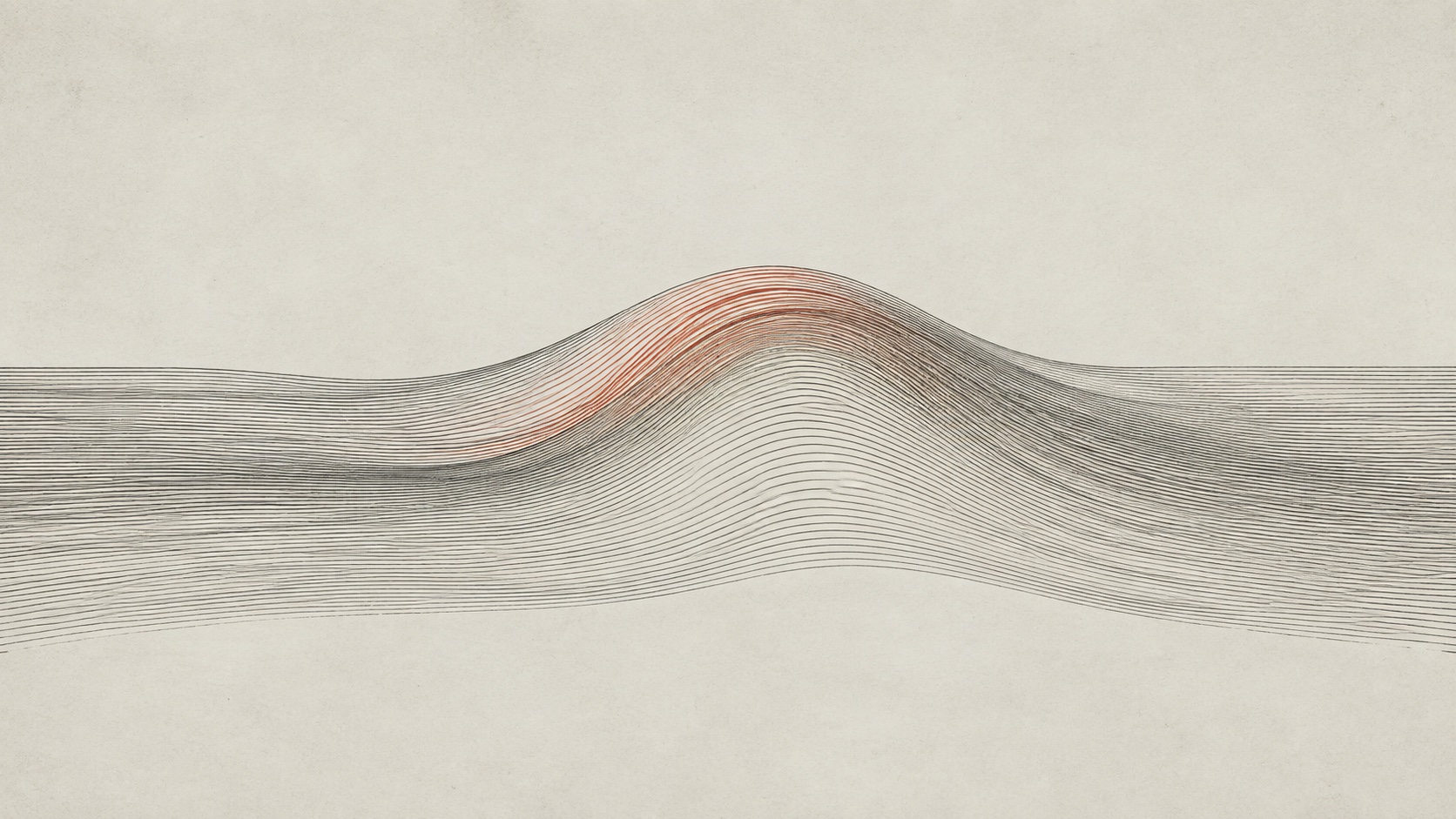
In the nineteenth century, Michael Faraday investigated electricity and magnetism, representing the action of magnets through lines of force. Iron filings helped reveal their pattern. The lines indicated the direction of the magnetic field. The space between objects became part of the explanation of how they interact.
James Clerk Maxwell developed a mathematical theory of the electromagnetic field. His equations contained waves travelling at the speed of light. Published in 1865, the work connected optical and electromagnetic phenomena. Light found a place in the same theory that described electric currents and magnets.
From wave to particle
You can see a guitar string vibrate. Its points move as a disturbance travels along the string. A string fixed at its ends has particular modes of vibration, each with its own frequency. This image helps us picture how a single system can allow different excitations.
Beyond that, the analogy needs care. A classical string can vibrate more or less strongly, with its energy changing smoothly. Quantum theory describes excitations differently. For each mode of a free field, energy is added in specific portions. For the electromagnetic field, these quanta correspond to photons.
An electron is also described as a quantum excitation of a field: the electron field. Calculating its behaviour requires quantum states and probabilities for measurement outcomes. A drawing of a wave conveys only part of the idea: it does not show the electron’s shape in the way a photograph shows the shape of a guitar string.
Identical electrons
All electrons have the same mass, electric charge and spin. Electrons can be in different states, but they have no individual intrinsic labels that would let us distinguish one electron from another. In quantum field theory, this identity is built into the description: all electrons belong to the same type of field.
This structure of the theory lets us describe processes in which the number of particles changes. A collision can produce an electron and its antiparticle, a positron, if conservation laws permit the process and enough energy is available. A positron has the same mass as an electron and the opposite electric charge.
Paul Dirac derived his relativistic equation for the electron in 1928. In 1931, he predicted the antielectron. Carl Anderson discovered the positron in cosmic radiation in 1932. An antiparticle had become an observable object whose track could be examined in a chamber.
What binds matter together
Electrons and quarks are not enough to describe an atom. We also need to specify how they interact. The Standard Model describes the electromagnetic, strong and weak interactions. Each has associated fields and particles: the photon, gluons, and the W and Z bosons.
Quarks
- u
- up
- c
- charm
- t
- top
- d
- down
- s
- strange
- b
- bottom
Leptons
- e
- electron
- μ
- muon
- τ
- tau lepton
- νe
- electron neutrino
- νμ
- muon neutrino
- ντ
- tau neutrino
Bosons
- γ
- PhotonElectromagnetic interaction
- g
- GluonsStrong interaction
- W±, Z
- W and Z bosonsWeak interaction
- H
- Higgs bosonAn excitation of the Higgs field
The electromagnetic interaction acts on electrically charged particles. It helps bind electrons to nuclei and form molecules. The strong interaction binds quarks inside protons and neutrons. A residual nuclear interaction acts between protons and neutrons themselves, allowing bound nuclei to exist.
The weak interaction is involved in particle transformations. For example, in neutron beta decay, one of the neutron’s down quarks turns into an up quark. The neutron becomes a proton, and an electron and an electron antineutrino are produced. Weak processes are also essential to the chain of reactions through which the Sun converts hydrogen into helium.
The forces also differ in how they act. The electromagnetic interaction can operate over large distances. The weak interaction has a very short range, associated with the large masses of the W and Z bosons. Explaining those masses led to the Higgs field.
Mass and the Higgs field
In the Standard Model, the Higgs field has a nonzero average value even in the vacuum. Coupling to this field enters the description of the masses of electrons, quarks, and the W and Z bosons. The coupling strengths differ, and so do the masses.
Mass is sometimes explained through motion in a viscous medium. But a viscous medium slows an object down and dissipates its energy. A constant Higgs field does not create that kind of friction. Mass characterises the relationship between a particle’s energy and momentum, as well as its inertia. A particle with mass can move uniformly without spending energy to push through the background.
This mechanism is part of electroweak theory. In its present vacuum, the W and Z bosons have mass while the photon remains massless. This is why the electromagnetic and weak interactions have such different properties at low energies. Their unification does not mean that the unity of all forces, including the strong interaction and gravity, has been established.
Why a proton is heavier than its quarks
It may now seem that the Higgs field explains the mass of every object. But almost all of an atom’s mass is in its nucleus, and most of the mass of protons and neutrons is associated with the energy of quarks, gluons and their interactions. The masses of the light quarks themselves make a much smaller contribution.
A proton’s mass therefore cannot be obtained simply by adding the masses of its three valence quarks. The whole quantum system must be taken into account. The relationship between rest energy and mass, E = mc², applies to composite objects too.
Here, the familiar phrase ‘made of’ can easily mislead us. If we list the quarks but forget their interaction, most of the proton’s mass will be missing from the calculation. Interaction energy contributes to the mass of a composite system.
How to test whether a field exists
In 1983, experiments at CERN discovered the W and Z bosons. In 2012, the ATLAS and CMS collaborations announced the discovery of a new particle whose properties were consistent with those of the Higgs boson.
The Higgs boson decays rapidly. It is detected through its decay products. Researchers measure their energies and directions, compare many events with theoretical predictions, and test whether already known processes can explain the result.
In a teaching diagram, a field is often drawn as a surface with a wave. Experimental tests require measurements, probability calculations and statistical separation of signal from background. These can establish whether the theory’s predictions agree with observations.
What lies beyond
Gravity is not part of the Standard Model. General relativity describes it through the geometry of spacetime. The theory also predicts gravitational waves: propagating disturbances in spacetime geometry. LIGO recorded the first such signal on 14 September 2015; the discovery was announced in February 2016.
That confirmation does not yet provide an experimentally verified quantum theory of gravity. Nor has it been established whether space has a discrete structure at the very smallest scales. A picture of a grid or a grainy surface here illustrates a hypothesis.
The question of the vacuum remains. In quantum theory, it is the lowest-energy state, with physical properties of its own. Astronomical observations show that the expansion of the Universe is accelerating. Whether this is explained by quantum vacuum energy or requires a different physical cause has not yet been established.